MMA Completes Successful Asian Games Debut in Nagoya as First Champions Crowned

First ever MMA inclusion at the 2026 Asian Games Aichi Nagoya 2026 – Photo credit: Asian Mixed Martial Arts Association (AMMA)
24 September 2026
NAGOYA, Japan — Mixed martial arts has completed a successful and historic debut at the Asian Games in Aichi-Nagoya, with the first MMA champions in Asian Games history crowned following three days of high-level competition.
A total of 55 athletes representing 21 National Olympic Committees competed across six medal categories in Modern and Traditional MMA at the Nagoya City Inae Sports Centre from 20–22 September.
FIMMA President Gordon Tang said the Asian Games debut represented an important step for the sport and its athletes.
“Nagoya has shown what MMA can achieve within a major multi-sport environment,” said President Tang. “We are extremely proud of the athletes who competed here and of the quality of the competition they delivered. For MMA, this is an important milestone and an important step towards our ambition of Olympic recognition. There is still much work to do, but Nagoya has given us a strong foundation for the next stage of our journey.”
The competition gave athletes the opportunity to represent their countries on one of Asia’s biggest sporting stages, while making history for their sport.
“This gold medal means a lot not only to me but also to the entire nation. This is the first time MMA has been an official sport at the Asian Games. That’s why it means a lot,” said Thailand’s Kanjutha Phattaraboonsorn.
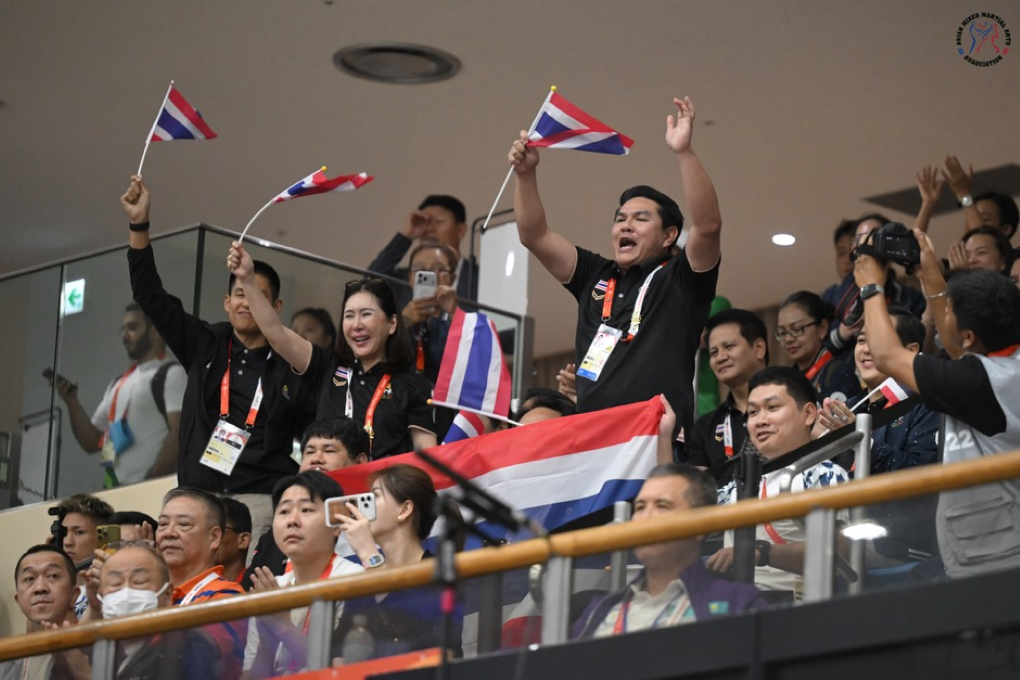
Thailand fans celebrating Kanjutha Phattaraboonsorn gold medal in women’s modern MMA -54kg – Photo credit: Asian Mixed Martial Arts Association (AMMA)
The event also received strong recognition from within the wider MMA community. Brazilian MMA legend Rodrigo Nogueira was in Nagoya for the Asian Games and highlighted the quality and format of the competition, saying: “Great to see MMA in the Asian Games. I like the rules, beautiful to watch, clean, no cage.”
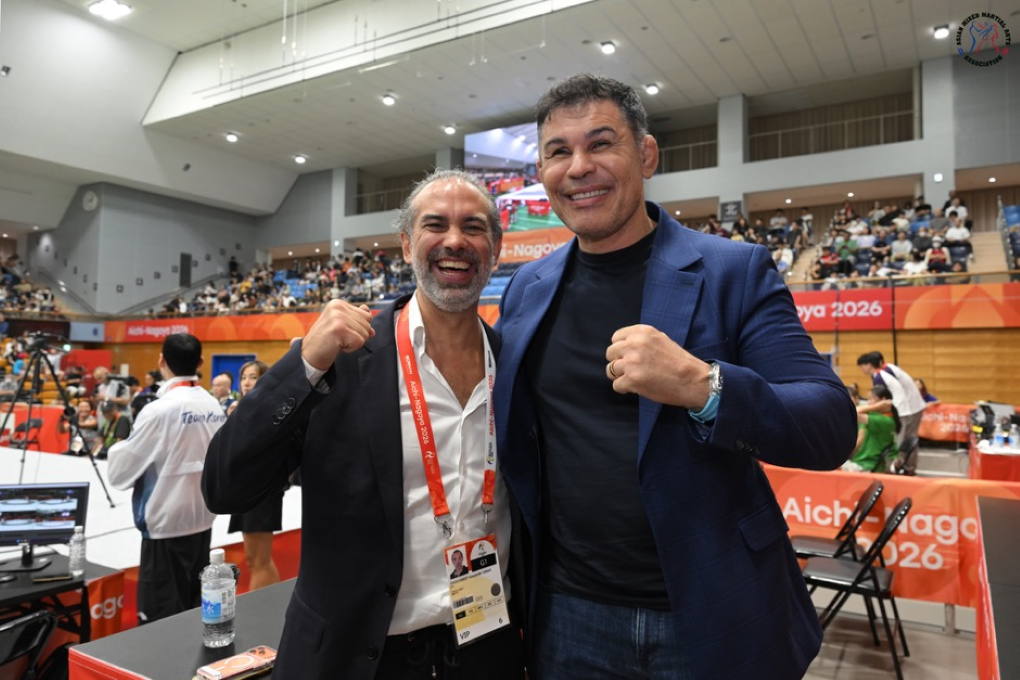
FIMMA Executive Vice President Alexander Engelhardt (left) and MMA legend (right) Rodrigo Nogueira in Nagoya – Photo credit: Asian Mixed Martial Arts Association (AMMA)
The ambition to see MMA continue its journey towards the Olympic Games was also strongly expressed by athletes.
“I hope and wait that MMA will become an Olympic sport. It’s not a dangerous sport. There are other sports that are more injury prone than MMA,” said Tajikistan’s Mirzobek Umarov, one of the gold medallists in Nagoya.
The successful delivery of the competition demonstrated that MMA can operate effectively within a major multi-sport environment.
The FIMMA ruleset allows competition to be delivered over three days, with different rounds and stages integrated into the Games schedule. The Open Field of Play replaces the traditional cage or ring, providing a format that is adaptable to a major multi-sport event while maintaining the competitive identity of MMA.
The inclusion of both Modern and Traditional MMA also reflected the diversity of martial arts backgrounds and pathways within the sport. FIMMA’s ruleset place emphasis on technical execution, control and the educational values of various forms of martial arts.
In Traditional MMA, athletes compete in a traditional martial arts uniform (Gi), with a stronger focus on grappling techniques. Modern MMA uses a more contemporary competitive ruleset with a stronger focus on striking.
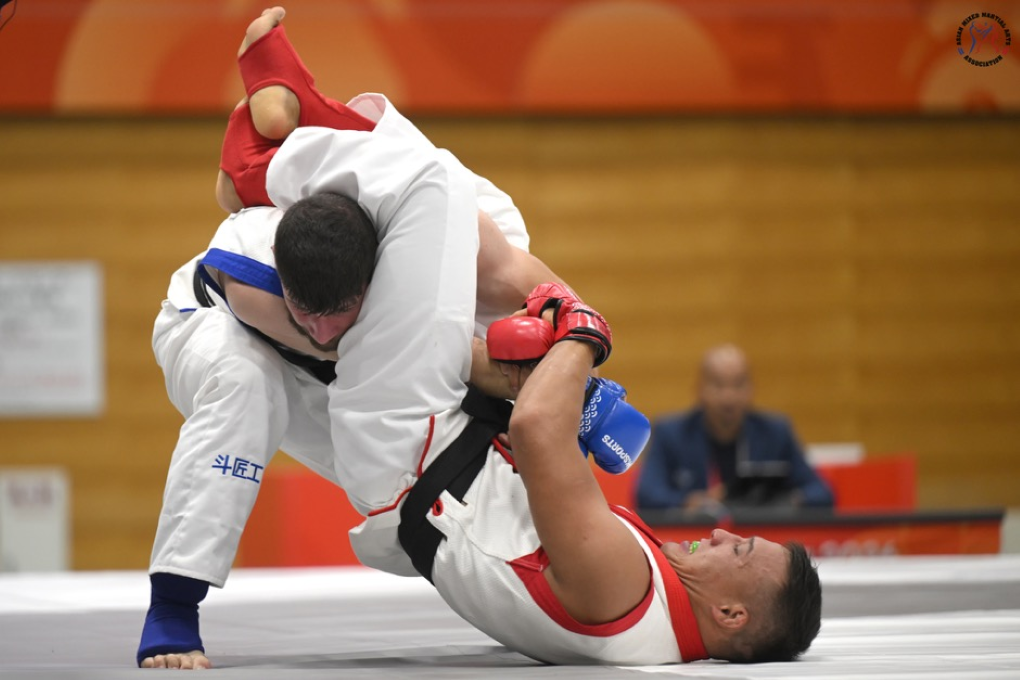
Men’s Traditional MMA – Photo credit: Asian Mixed Martial Arts Association (AMMA)
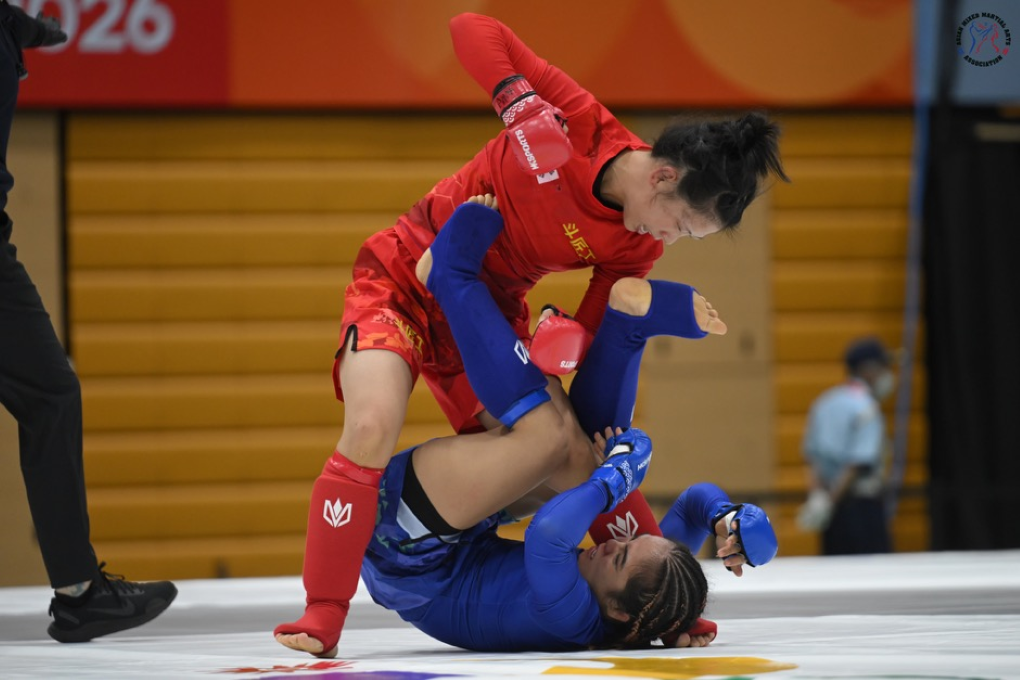
Women’s Modern MMA – Photo credit: Asian Mixed Martial Arts Association (AMMA)
Athlete safety is central to the FIMMA ruleset, supported by comprehensive medical, anti-doping and athlete-safety protocols, including thicker MMA gloves and shin guards to help minimise the risk of injury. No athletes required hospital admission during the three-day competition.
The competition was overseen by 33 International Technical Officials representing Asian National Federations, together with 14 National Technical Officials from Japan. The technical system used in Nagoya has been developed through AMMA’s Asian Championships, with regular technical meetings, continuous evaluation of officials and closer collaboration with National Federations.
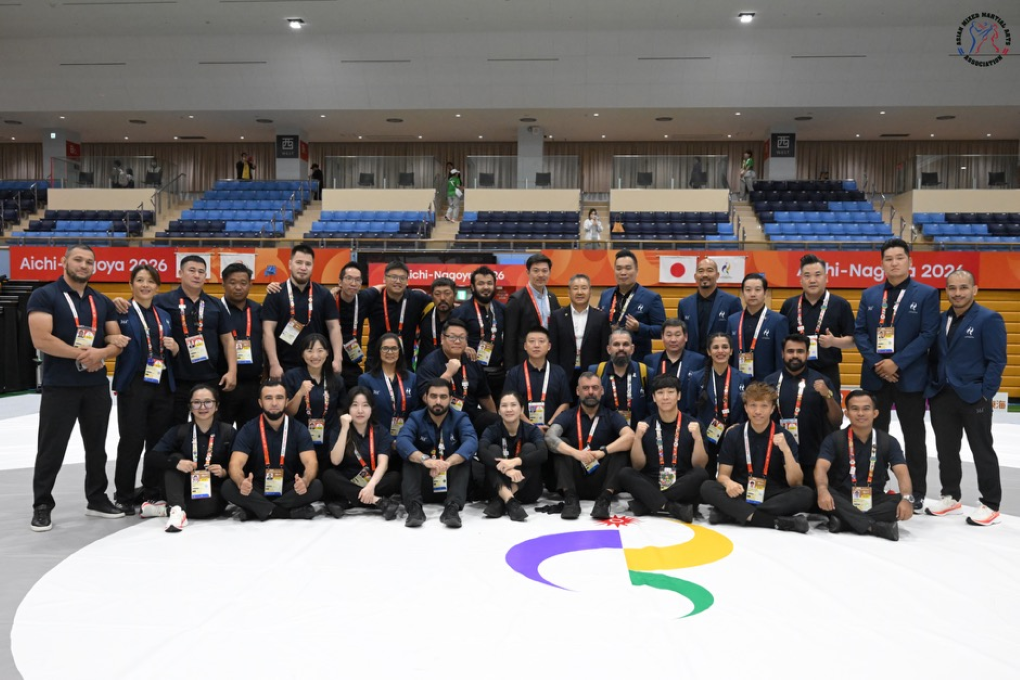
AMMA Technical Officials at the 2026 Asian Games Aichi-Nagoya – missing from above picture: Jitendra Khare (IND) and Alisher Karimov (TJK) – Photo credit: Asian Mixed Martial Arts Association (AMMA)
FIMMA also hosted continental sporting stakeholders from Africa and Europe in Nagoya, providing an opportunity to discuss the future development of MMA and its continued integration into major multi-sport events.

From left to right: ANOCA 3rd Vice President Alfred Foloko, Nigeria Olympic President and IOC Honorary Member Habu Gumel, FIMMA President Gordon Tang and Moncef Zemmouchi – Photo credit: Asian Mixed Martial Arts Association (AMMA)
The successful completion of the Asian Games provides an important foundation for MMA’s continued international development and its ambition to achieve Olympic recognition. The next focus will be on expanding MMA’s presence within major multi-sport events worldwide, developing the international competition pathway and preparing for the first FIMMA World Championships.
The first Asian Games MMA champions have been crowned. The journey towards Olympic recognition continues.